Reviewed by Turf & Community Captains
5-a-side or 7-a-side? Compare pitch dimensions, tactical formation boards, gameplay dynamics, and rules to choose the right turf format for your squad.
When booking a football turf in Indian cities, the two most common formats are 5-a-side and 7-a-side. While both are played on artificial grass cages, they require completely different tactical approaches, fitness levels, and pitch sizes.
Choosing the right format depends on how many players you have and whether your group prefers fast-paced one-touch passing or tactical space and long balls.
Here is the complete guide comparing 5-a-side and 7-a-side turf football, complete with detailed tactical formation boards for every squad setup.
1. Pitch Dimensions and Space
The physical size of the pitch changes how the game feels:
- 5-a-Side Pitches: Typically 80 to 100 feet long by 50 to 60 feet wide. Enclosed by safety netting on all sides, the ball rarely goes out of play. This creates non-stop action with zero downtime.
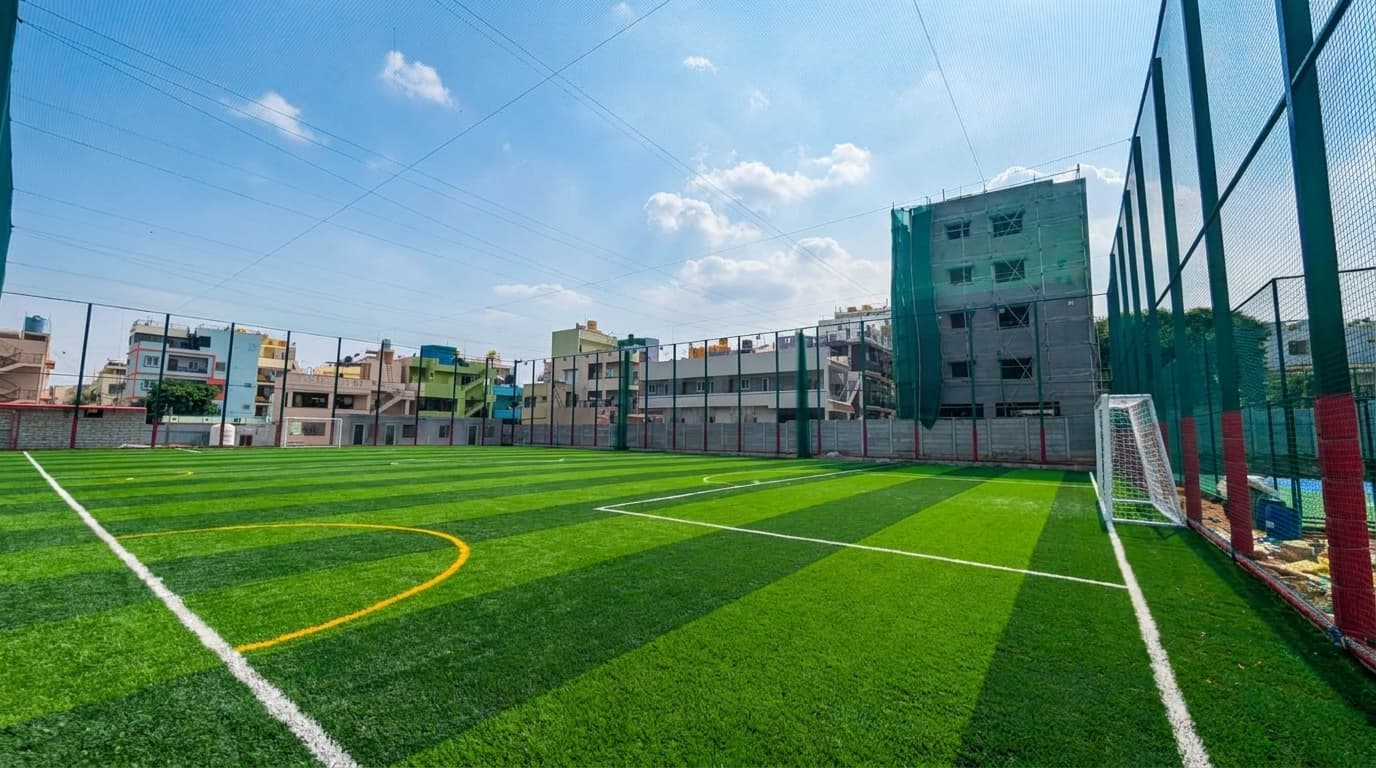
- 7-a-Side Pitches: Usually 140 to 170 feet long by 90 to 110 feet wide (roughly half the size of a full 11-a-side stadium pitch). Larger goals (often 12 × 6 feet or 16 × 7 feet) allow for genuine crossing and long-range shooting.
Because 5-a-side turf cages are compact, defenders are on you in less than two seconds. In 7-a-side, wingers have space to sprint into channels and deliver cutbacks.
2. Rules and Gameplay Differences
- Goalkeeper Area: In 5-a-side, outfield players cannot enter the D-box. In 7-a-side, a standard penalty box is used with sliding allowed.
- Offside Rule: No offside in either 5-a-side or 7-a-side on amateur turfs.
- Ball Height: Casual 5-a-side often uses head-height restrictions to encourage ground play, while 7-a-side has no height limits.
- Restarts: 5-a-side uses kick-ins or continuous cage rebounding. 7-a-side uses standard underarm throw-ins or kick-ins.
- Footwear: Rubber turf shoes (TF) are strongly recommended for both formats.
For advice on choosing boots that protect your knees and ankles on synthetic carpets, read our breakdown on turf shoes vs studs for artificial pitches.
3. Best 5-a-Side Formations Explained

With only four outfield players, every player must contribute to both phases of the game.
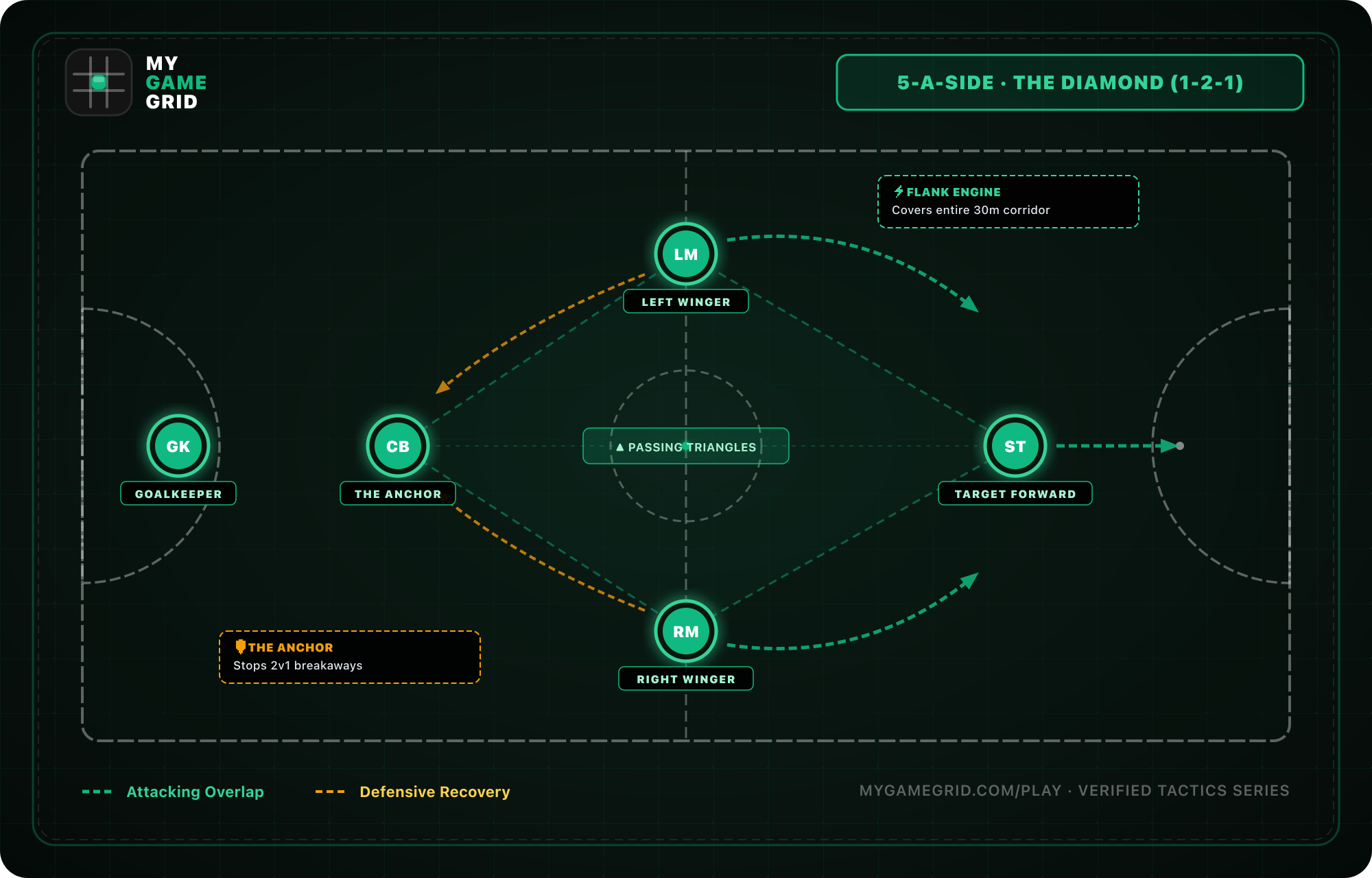
The Diamond (1-2-1)
The Diamond is the most popular formation in world futsal and Indian 5-a-side turf matches because it provides perfect balance across every third of the pitch.
- How It Works: One disciplined central defender (the Anchor) stays back, two wingers provide width on the flanks, and one target striker stays high up the pitch.
- In Attack: When the anchor plays the ball to the left winger, the right winger makes a diagonal run into the box while the striker drags defenders wide. This creates natural passing triangles.
- In Defense: Both wingers immediately track back to flank the central defender, compressing the team into a tight 3-man wall in front of the D-box.
- When to Use It: When your two wingers have high stamina and can run box-to-box for the full 50 minutes.
- Critical Vulnerability: If both wingers push too high at the same time and lose the ball, your lone defender is left in a 2v1 counter-attack.
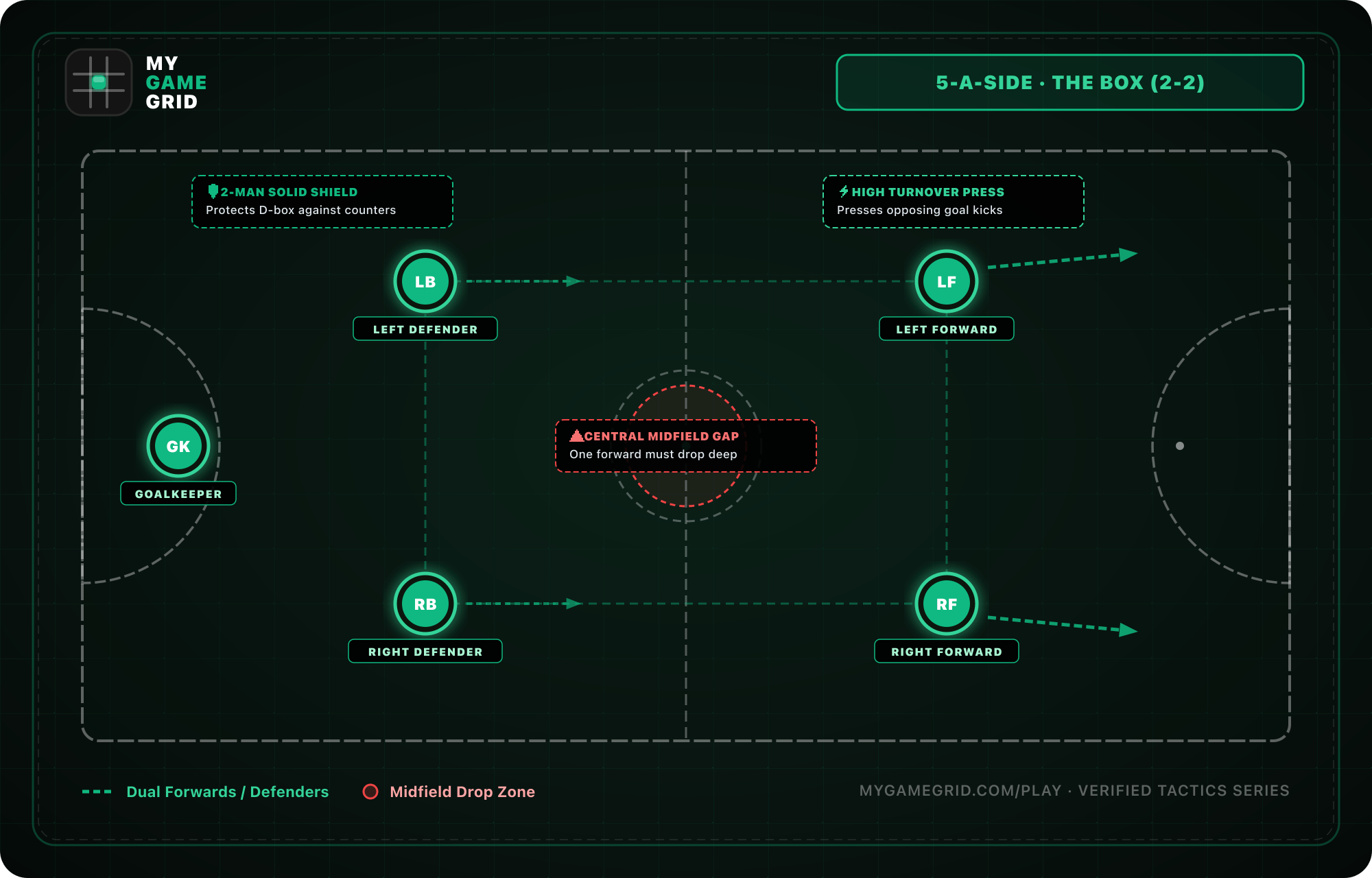
The Box (2-2)
The Box splits the pitch into two strict zones: two dedicated defenders and two high forwards.

- How It Works: Two defenders stay locked in their defensive half, while two forwards stay in the opponent half to apply constant pressure on their goal kicks.
- In Attack: The two forwards pass laterally and look for quick give-and-go one-twos to generate close-range shots.
- In Defense: The two defenders form a solid wall in front of goal, forcing opponents to take low-percentage shots from tight angles.
- When to Use It: When your squad has two natural defenders who prefer not to run forward, or against opponents with deadly counter-attacking forwards.
- Critical Vulnerability: The large empty space in central midfield. If the forwards do not drop deep to collect passes, the defenders are forced into risky long balls.
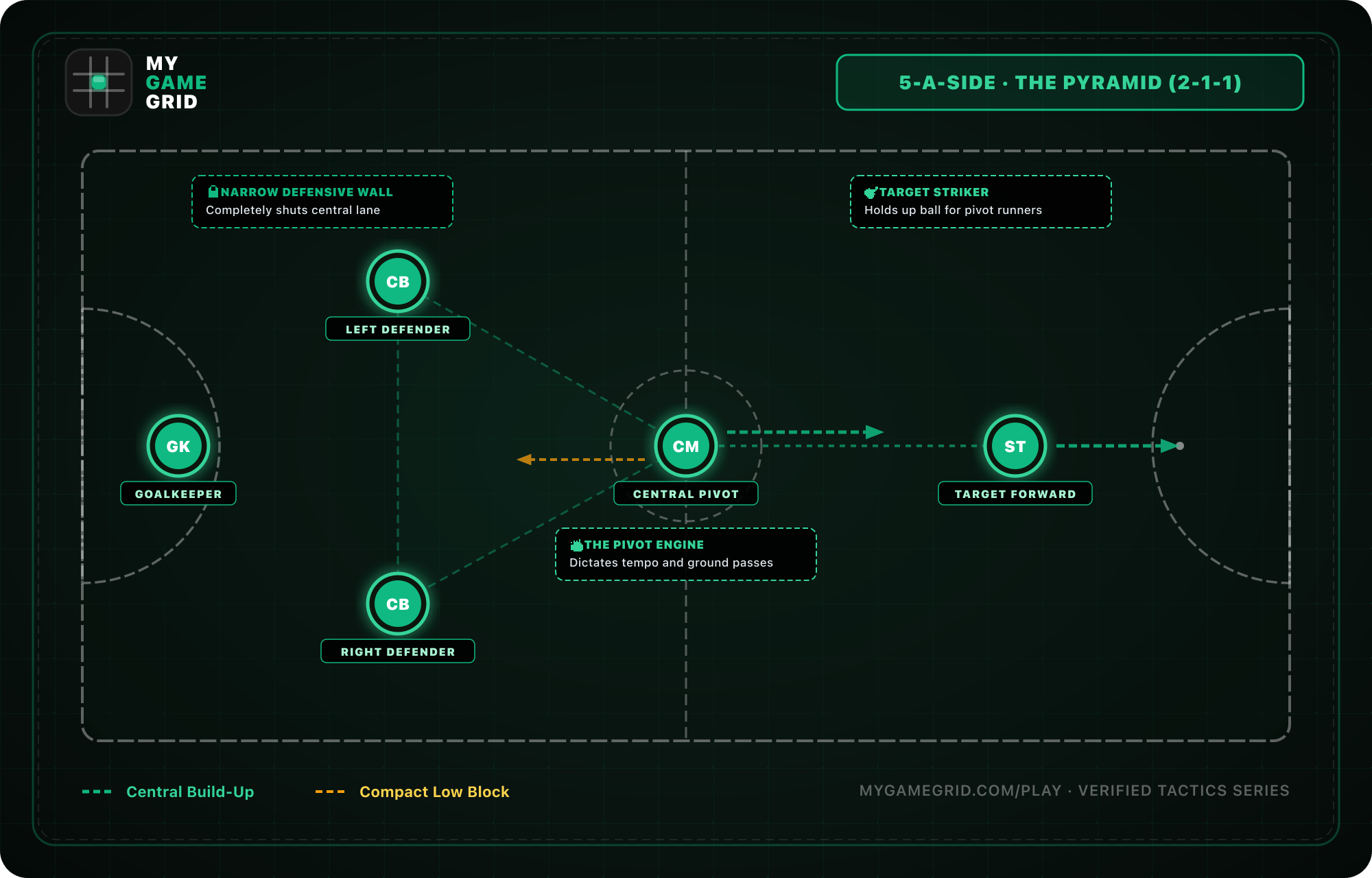
The Pyramid (2-1-1)
The Pyramid is the ultimate defensive formation for locking down games and frustrating attacking opponents.

- How It Works: Two solid centre-backs, one central midfield pivot who dictates the tempo, and one target forward who holds up the ball.
- In Attack: The midfielder acts as the engine, collecting balls from the defenders and threading ground passes to the lone striker.
- In Defense: The team forms a narrow triangle that completely shuts down central passing lanes.
- When to Use It: When defending a 1-goal lead in the final 10 minutes of a tournament knockout, or when facing a team with superior individual dribblers.
- Critical Vulnerability: Lack of natural width. Without wingers, your lone striker can become isolated if the central midfielder gets marked out of the game.
4. Best 7-a-Side Formations Explained

On a larger 7-a-side pitch, tactical structure is essential. Without a clear formation, teams get stretched and tire out within 20 minutes.
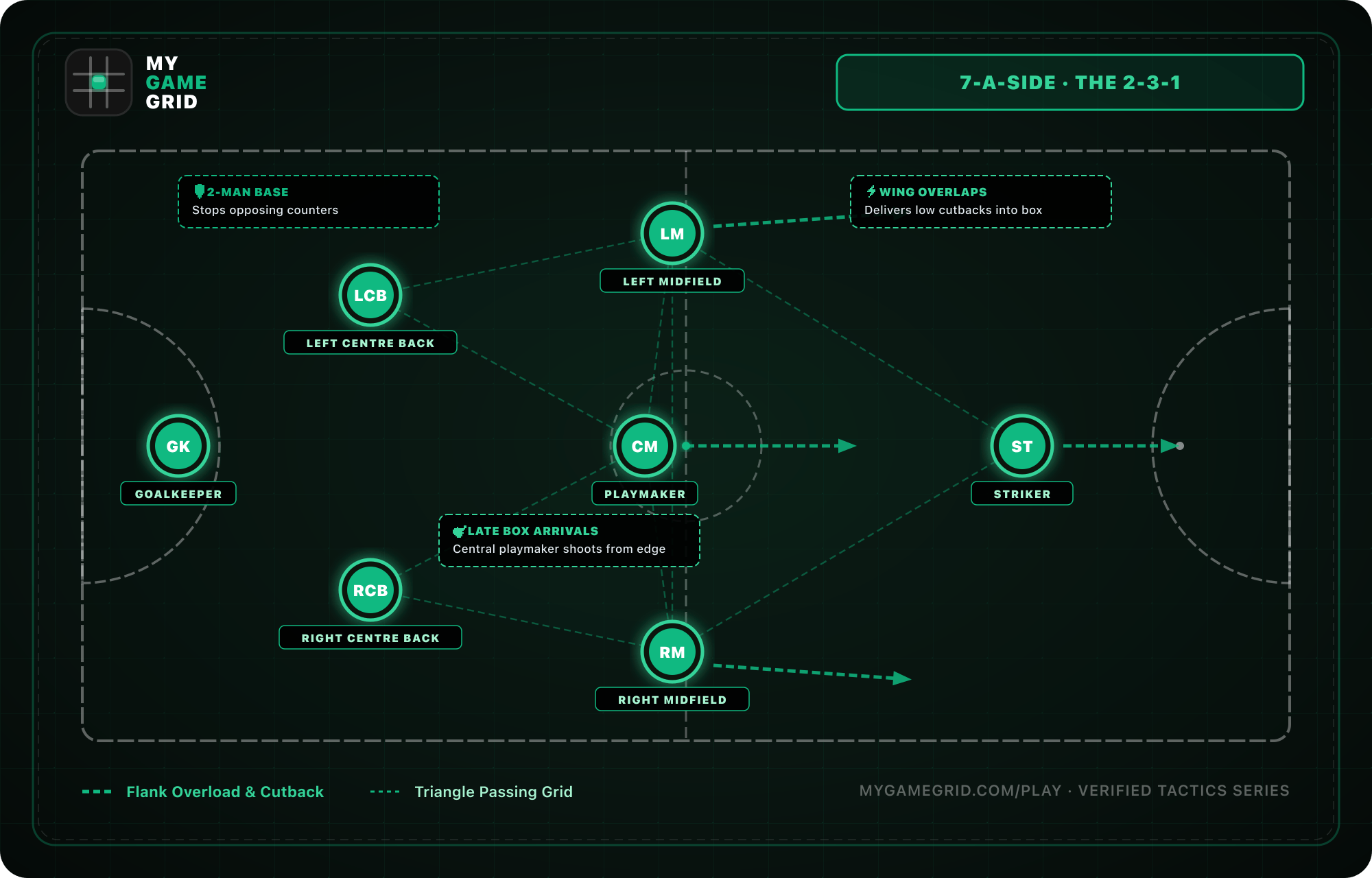
The 2-3-1 Formation
The 2-3-1 is the gold standard modern shape for 7-a-side football.
- How It Works: Two centre-backs split the defensive load, a midfield trio (left wing, central playmaker, right wing) controls the tempo, and a clinical striker leads the line.
- In Attack: Wingers can overlap high and deliver low cutbacks into the penalty box. The central midfielder arrives late on the edge of the area for cutback shots.
- In Defense: The wide midfielders drop back to form a 4-man defensive unit with the centre-backs.
- When to Use It: The best all-round formation for balanced squads. Works well against almost any opponent shape.
- Critical Vulnerability: The space behind the wide midfielders. If your wingers get caught high, the opposing team can break quickly into the channels.
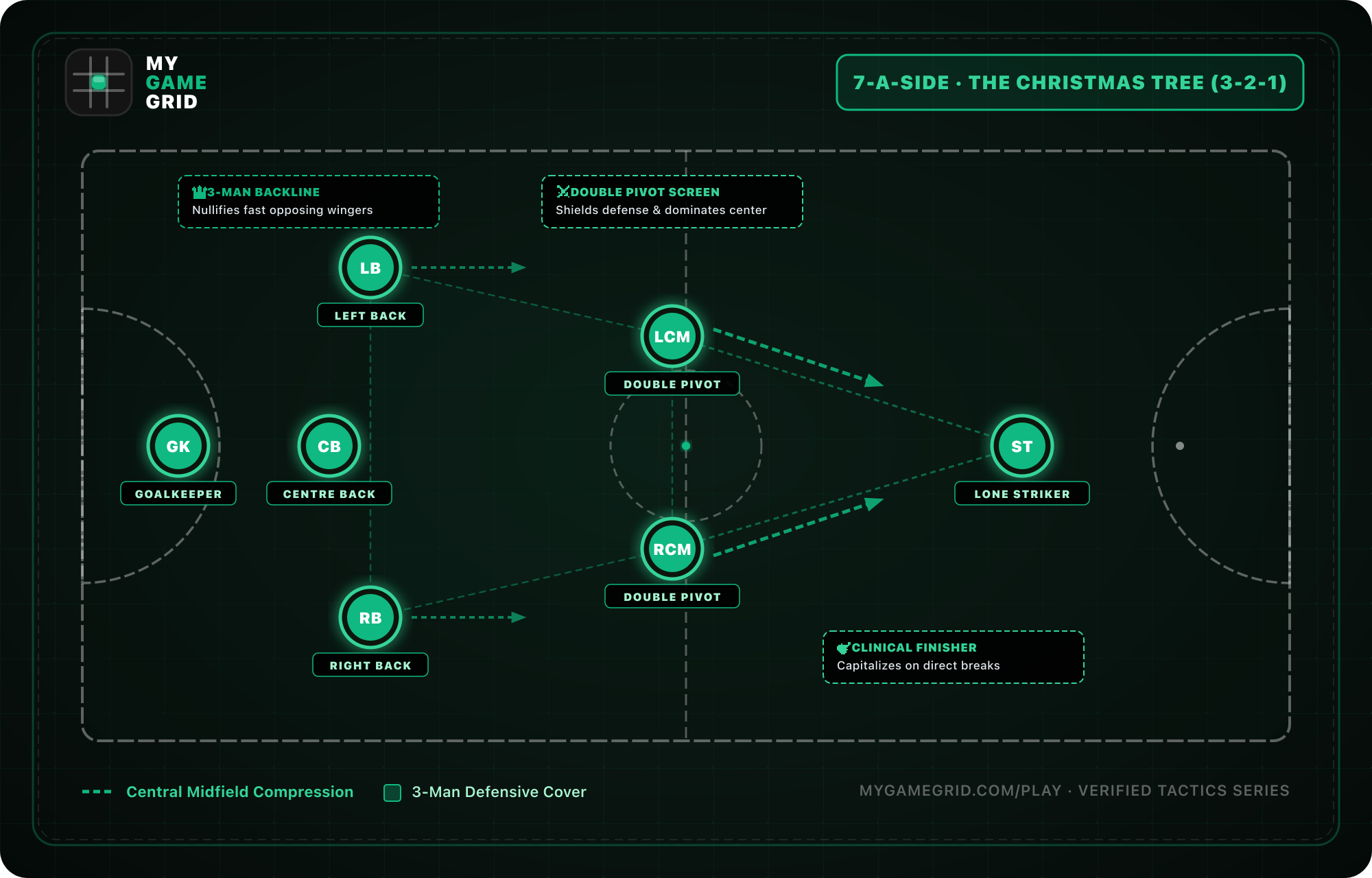
The Christmas Tree (3-2-1)
The 3-2-1 provides rock-solid defensive stability while controlling the middle of the park through a double pivot.

- How It Works: Three defenders (left back, central defender, right back), two central box-to-box midfielders, and one mobile striker.
- In Attack: The wide full-backs push up into midfield, while the two central midfielders link with the striker through quick central combinations.
- In Defense: The 3-man backline prevents any 1v1 overloads, while the two central midfielders shield the defenders from long-range efforts.
- When to Use It: When playing against aggressive attacking teams with fast wingers.
- Critical Vulnerability: Can become overly defensive if full-backs are hesitant to push forward in transition.
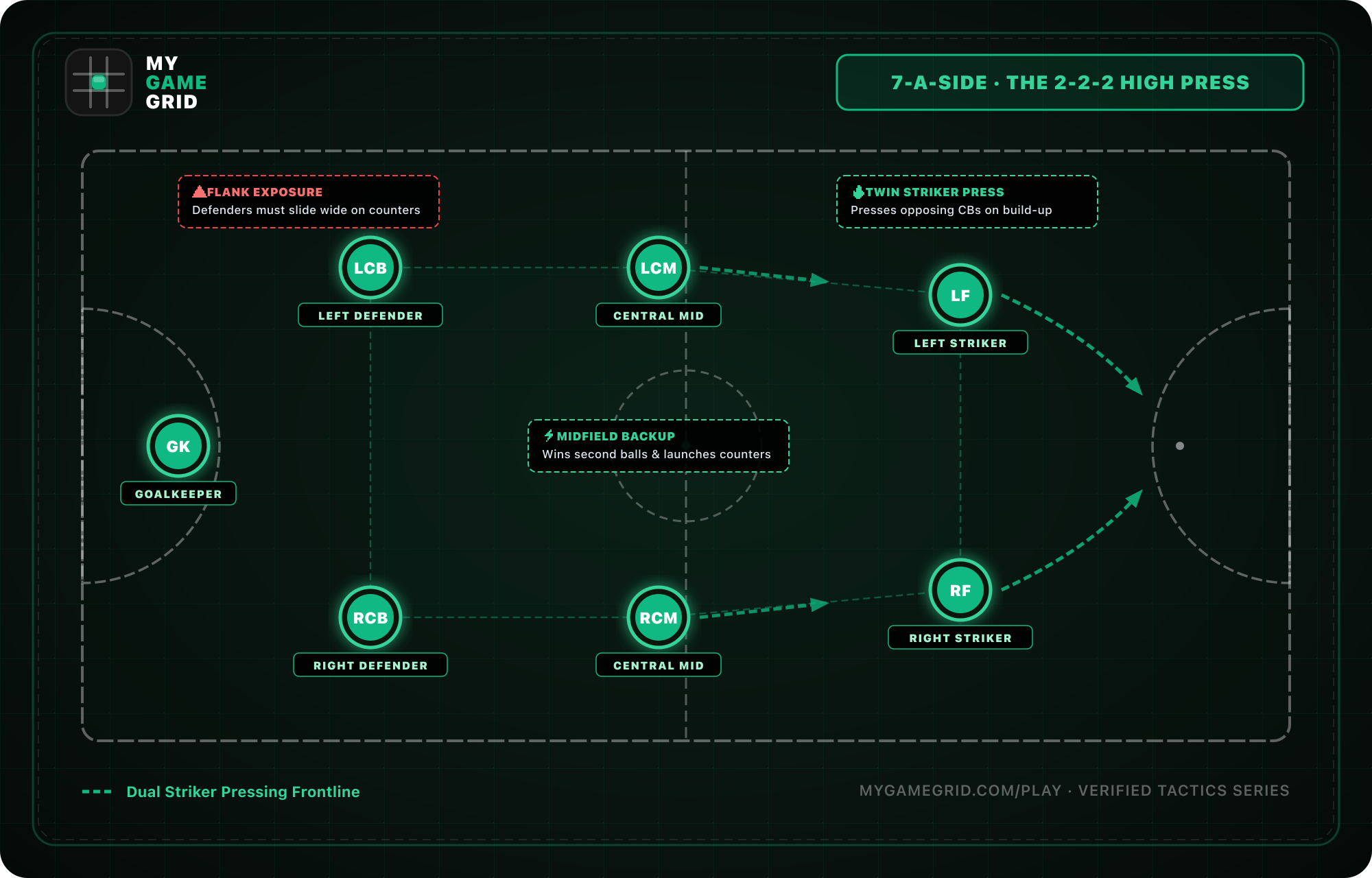
The 2-2-2 High Press
The 2-2-2 is an all-out attacking formation designed to overwhelm opponents in their own half.

- How It Works: Two defenders, two central midfielders, and a twin striker partnership up front.
- In Attack: Twin strikers create constant 2v2 pressure against opposing centre-backs, creating chances from turnovers high up the pitch.
- In Defense: The front two press immediately upon losing possession, winning the ball in dangerous attacking zones.
- When to Use It: When you need a goal in the second half or when facing an opponent that struggles to play out from the back.
- Critical Vulnerability: Lack of defensive width. If the opponent beats the initial two-man press, they have wide open green grass to attack down the wings.
5. Which Format Should You Play?
- Choose 5-a-Side if: You have 10 to 12 players, want a high-intensity cardio workout, and love quick one-touch passing in tight corners.
- Choose 7-a-Side if: You have 14 to 18 players, have players who prefer specialized positions (like dedicated wingers or holding midfielders), and want to practice set pieces and through balls.
If you are planning to run a competitive weekend cup for either format, check out our guide on how to organise a 5-a-side football tournament.
Frequently Asked Questions
Q: Can you slide tackle in 5-a-side or 7-a-side turf games?
A: Almost all amateur turfs in India prohibit slide tackles. Turf burns are painful, and sliding on synthetic carpet risks injuring both players. Stay on your feet and jockey.
Q: What is the ideal match duration for casual turf games?
A: Most groups book a 60-minute or 90-minute slot. For 5-a-side, play two 25-minute halves with a 5-minute break. For 7-a-side, 30-minute halves work best.
Q: How many substitutes should a team bring?
A: Bringing 2 to 3 substitutes per team ensures everyone gets sufficient game time without getting exhausted.
Get Out on the Turf
Whether you prefer the rapid pace of 5-a-side or the tactical space of 7-a-side, your next game is waiting. Browse open matches on MyGameGrid Play or reserve a pitch for your squad on MyGameGrid Facility Booking.
Find a Game Near You
Browse open football and community sports games happening this week in your city. Pick your slot, show up, play.
More from GameFeed
Guides and stories to level up your game.

How to Join a Pickup Football Game in Bangalore (Without Knowing Anyone)
Want to play football in Bangalore but do not have a team? Here is exactly how to find and join pickup football games near you — no squad needed, no experience required.
How to Host a Match
Learn how to host pickup football, badminton, and box cricket matches: format selection, smart team balancing, in-app UPI verification, and live scorecards.

How to Organise a 5-a-Side Football Tournament: Complete Checklist
Hosting a 5-a-side football tournament? Follow this complete checklist covering formats, ground rules, turf booking buffer times, and digital brackets.